


Architectural Lighting Design, Oxford
Light House Designs was appointed to deliver a fully integrated architectural lighting design scheme for The Levine Building at Trinity College Oxford.
Designed by Adam Architecture, the building sits within one of Oxford’s most historically sensitive collegiate environments.
The brief required a lighting strategy capable of supporting multiple uses—teaching, performance, study and social space—while maintaining architectural clarity and restraint.
The Challenge
Oxford is not a forgiving context.
Every new building must respond to a centuries-old architectural language—one that demands sensitivity without imitation.
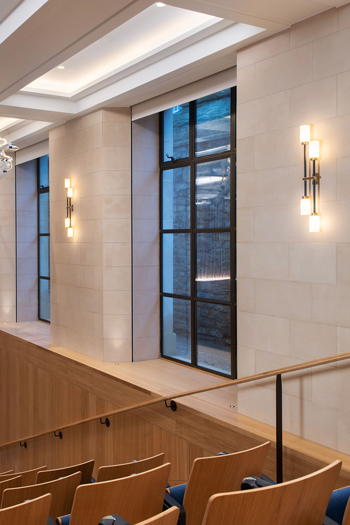
Externally, The Levine Building is constructed in traditional Oxford stone. Internally, the architecture shifts: coffered ceilings, timber slatted acoustic screens, deep chamfered window reveals and expansive glazing create a contemporary, multifunctional environment.
The programme includes:
- Auditorium
- Library
- Function room
- Atrium café
- Student accommodation
Each space carries distinct requirements, yet all must function cohesively within a single building.
Design Approach: Architecture First
Our approach was consistent throughout: architecture first, always.
The Levine Building operates across multiple identities throughout the day—lecture, performance, study and social space.
This required a layered, highly controllable lighting strategy, where every element supports both function and form.
The Atrium Café
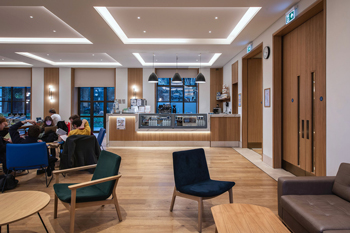
The atrium café is the social heart of the building.
A fixed 2700K warm white LED scheme is integrated within the ceiling coffers, providing a stable ambient layer. Recessed high-CRI luminaires (CRI 90+) deliver general illumination with low glare and strong visual comfort.
A scene-based control system allows the space to adapt seamlessly throughout the day.
The Auditorium
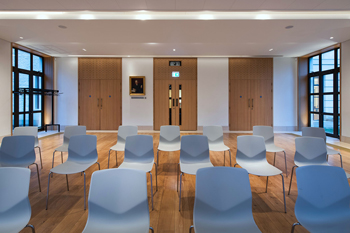
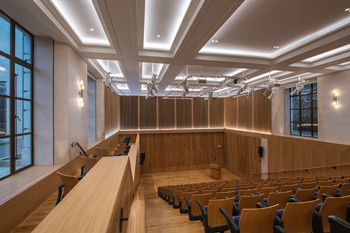
The auditorium requires a higher level of flexibility.
Tunable white LED strips (2200K–4000K) allow the space to shift between lecture, performance and exhibition. Independent dimming circuits emphasise the timber acoustic screen without visible theatrical lighting.
Lighting levels were modelled in line with CIBSE guidance. Emergency lighting is fully integrated.
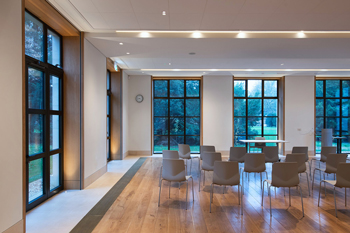
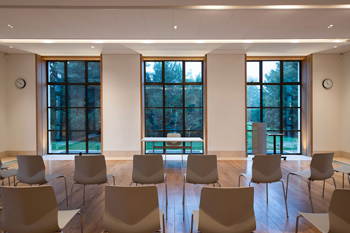
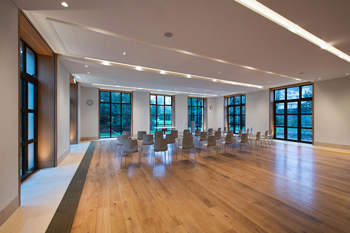
The Function Room
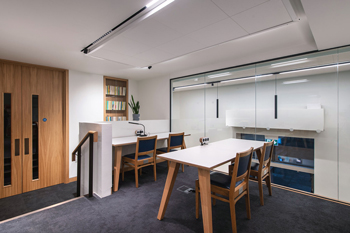
Concealed track luminaires are integrated within ceiling slots aligned to the coffered ceiling geometry.
This allows flexibility of use while maintaining a clean ceiling plane.
The Library
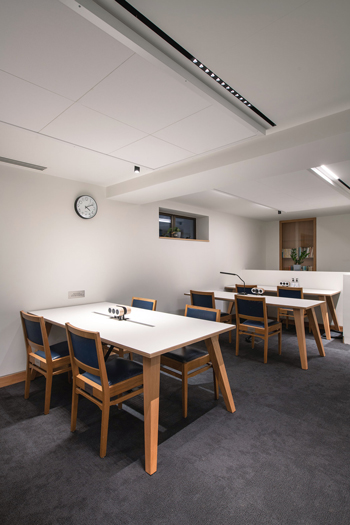
The library lighting is designed for visual comfort and sustained use.
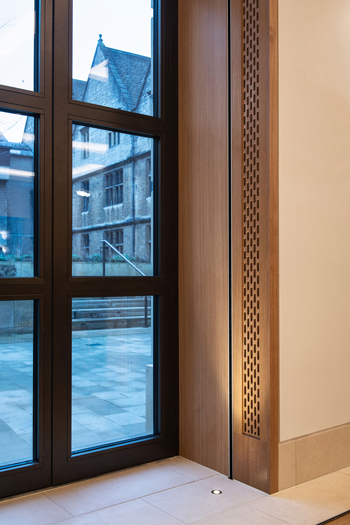
Recessed track luminaires provide ambient light, while concealed linear LEDs within window reveals extend the quality of daylight into evening hours.
Warm white (3000K) supports concentration and reduces fatigue.








Student Accommodation
Durability was key.
The scheme includes:
- Recessed downlights
- Bedside reading lights
- Desk lighting
- PIR-controlled circulation
- Integrated emergency lighting
Sustainability and Performance
LED lighting is used throughout, supporting Part L compliance.
Scene-setting and occupancy control reduce energy demand, while robust specification ensures longevity.
Outcome
The Levine Building demonstrates how architectural lighting design in Oxford can operate within a sensitive historic context.
The result is a building that transforms seamlessly throughout the day—technically precise, visually calm and fully integrated.
Architectural lighting design in Oxford
Explore more architectural lighting projects in Oxford and the Cotswolds
FAQs – Architectural Lighting Design
An architectural lighting designer develops a lighting strategy that enhances how a building performs and is experienced.
Lighting must respect the architectural context and avoid visual disruption.
By creating layered, controllable lighting that adapts to different uses.
Layered lighting combines ambient, task and accent light to create depth and flexibility.